
Rebecca Ferguson as Captain Olivia Walker in A House of Dynamite. Photo credit: Eros Hoagland/Netflix © 2025
Kathryn Bigelow’s A House of Dynamite is a gripping thriller that captures the terrifying speed of a nuclear crisis. It gets key things right: the short decision window, the structure of nuclear command, and the systemic risks.
But it leaves out crucial context. The systems we’re told will keep us safe—like missile defense and the trillion-dollar nuclear arsenal—are more fragile, costly, and under-examined than most people realize.
This post highlights three truths it gets right—and three realities it leaves out. Together, they reveal a deeper danger: not just in the drama, but in the design.
What the Film Gets Right
1. The 18-Minute Window
The film’s premise—that U.S. officials have just 18 minutes to respond to a nuclear launch—isn’t fiction. It’s disturbingly close to reality.
A Russian land-based missile would take 25-30 minutes to reach U.S. targets. A submarine-launched missile from offshore could arrive in 10-15 minutes—or less. The film’s 18-minute window falls between these extremes. It’s a plausible average—and a terrifying one.
In that time:
- Military systems must detect and verify the launch
- The president must be briefed, and given retaliatory options
- A decision must be made—with no guarantee of accuracy, no time for diplomacy, and no room for error
This timeline isn’t a safeguard. It’s a trap. It forces irreversible decisions under pressure and uncertainty. And if the alert is false, as it has been before, there’s no undo button.
The 18-minute window isn’t just dramatic. It’s a moral hazard—and a warning about the fragility of rapid retaliation.
2. The Chain of Command
In the film, we see the President, military commanders, and civilian advisors scrambling to assess the threat and consider response options. These scenes are dramatized—but the structure is accurate.
Under current U.S. policy, the President has sole authority to order the launch of nuclear weapons. That authority does not require approval from Congress, the courts, or even the Secretary of Defense. Once the order is given, it must be carried out.
This process can unfold in minutes.
This structure was designed for speed during the Cold War—when retaliation had to be immediate. But today, it raises profound questions:
- Should one person have unchecked authority over global annihilation?
- What happens if the threat is misidentified, or the President is misinformed?
- Where are the safeguards against error, escalation, or abuse?
The chain of command is real. The drama is real. And the consequences are irreversible.
3. Disaster by Design
The film doesn’t hinge on a rogue actor or irrational leader. It shows something more chilling: a system functioning exactly as intended.
- Military officers follow protocol.
- Advisors relay intelligence.
- The president needs to make a decision.
And catastrophe looms. Even rational decision makers, following procedures, are led toward annihilation.
That’s not a malfunction. That’s the design.
It raises the question: If the system of nuclear deterrence is so fragile, why do we keep it?
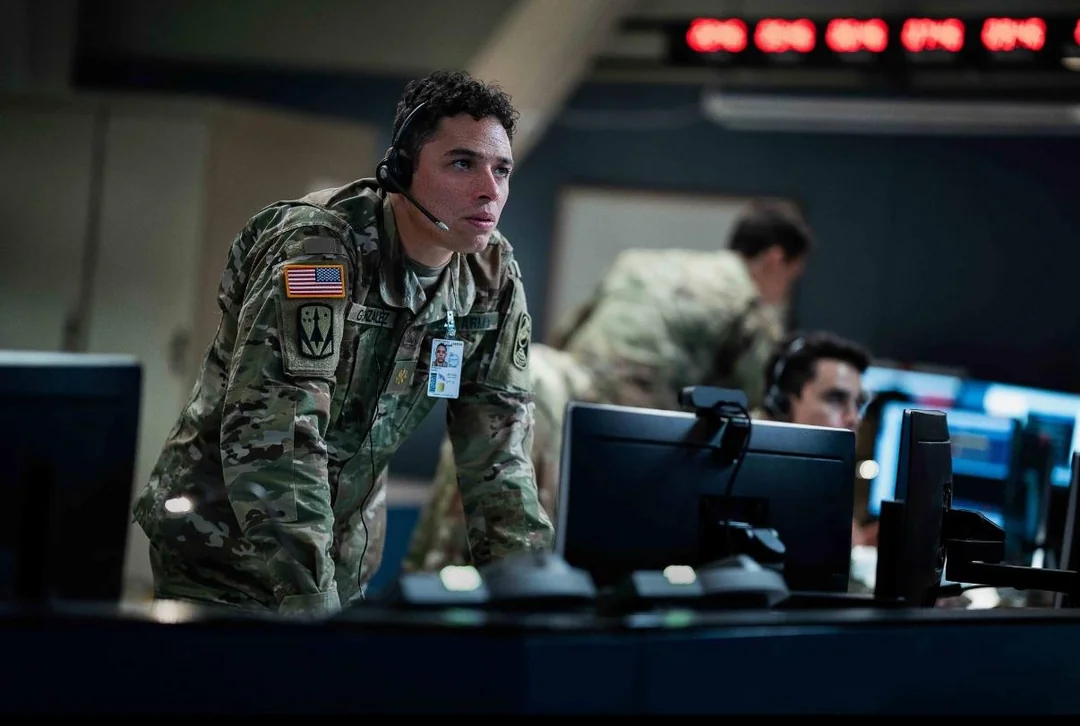
Anthony Ramos as Major Daniel Gonzalez in A House of Dynamite. Photo credit: Eros Hoagland/Netflix © 2025
What’s Still Missing
1. Missile Defense Was Never Going to Work
One of the most revealing moments in A House of Dynamite comes when the Secretary of Defense demands to know the odds of intercepting the incoming missile. The Deputy National Security Advisor hesitates—he knows the number, but he’s afraid to say it.
Finally, he admits:
In testing… the success rate has been 61%.
The Secretary of Defense explodes:
So it’s a f***ing coin toss?! That’s what $50 billion buys us?
But in reality, the situation is even worse.
That 61% figure comes from actual, real-life highly controlled tests in which the system knows the exact launch time, location, trajectory, and speed. There are no decoys. No multiple warheads. No chaos. Even under these perfect conditions, the system still fails 40% of the time.
In a real-world attack, the odds plummet. Modern intercontinental ballistic missiles travel at 15-20,000 miles per hour (Mach 20+), carry multiple warheads and a diverse range of decoys designed to mimic the real thing. The kill vehicles can’t reliably tell them apart. Under those conditions, the success rate wouldn’t even be a coin toss—it would likely be close to zero.
Experts have been blunt:
Pentagon officials “are systematically lying about the performance of a weapon system that is supposed to defend the people of the United States from nuclear attack.”
— Dr. Theodore Postol, physicist and professor emeritus at MIT, quoted in The New York Times, 2000
New technology should be subjected to realistic operational testing before production and deployment.
— Philip Coyle, former Director of Operational Test and Evaluation, U.S. Department of Defense, in an article on national missile defense
There’s nobody in uniform that I know who believes that this is a workable concept.
— Defense Secretary Robert Gates, testimony before Congress, 2009
This is what the film doesn’t explain. Without that context, viewers might walk away thinking the solution is to build more interceptors. But the real takeaway is this: missile defense is not a shield. It’s an illusion.
2. The Cost Already Paid
The film centers on decision-makers—but we already have victims of nuclear weapons.
- Downwinders and uranium miners were exposed to radiation from U.S. testing and extraction, often without consent or compensation.
- Indigenous nations have had their lands targeted for mining, weapons testing, and nuclear waste storage—violating sovereignty and desecrating sacred sites.
- Civilians near transport routes live with daily risk and zero transparency, unaware of the dangers moving through their communities.
- Survivors of Hiroshima and Nagasaki carry lifelong trauma and warnings we still ignore—testimonies that challenge the myth of necessity and deterrence.
These aren’t hypothetical casualties—they’re real people. Their suffering is ongoing, generational, and largely invisible in mainstream narratives.
Almost 100% of my immediate family has had cancer. And my family’s not unique.
— Tina Cordova, Co-founder, Tularosa Basin Downwinders Consortium and the fourth generation in her family diagnosed with cancer since the Trinity Test, from Live on Native Bidaské
One film can’t cover everything—but it’s important to name this omission. Because without these voices, the story remains partial. And when the public remembers only the policymakers—not the people already harmed—the system escapes accountability.
3. Funding Annihilation, Defunding Care
The film conveys urgency—but not the staggering cost. Over the next ten years, the United States is expected to invest more than $1 trillion in nuclear weapons—and potentially hundreds of billions more on President Trump’s proposed “Golden Dome” missile defense system. That’s not just a number—it’s a choice. Every dollar allocated to this system is a dollar not spent on the foundations of a just and secure society.
To put it in perspective:
- That trillion could build millions of affordable homes, easing the housing crisis.
- It could fully fund universal pre-K and tuition-free college, unlocking opportunity for generations.
- It could expand healthcare access, lower prescription costs, and strengthen mental health services.
- It could supercharge climate resilience, from clean energy to disaster preparedness.
This isn’t theoretical. These are real trade-offs. Communities across the country are struggling with underfunded schools, crumbling infrastructure, and unaffordable care—while nuclear budgets balloon with little public scrutiny.
We need to ask: What are we sacrificing to maintain this system? And more urgently: Who benefits—and who bears the cost?
Call to Action: From Alarm to Advocacy
A House of Dynamite is a powerful film. But it’s just a starting point. If we want real security, we need to go beyond dramatization—and confront the full truth of the system we’ve built.
If this film sparked an interest in further understanding nuclear weapons, explore our Beginner’s Guide to Nuclear Weapons, which breaks down their risks, myths, and real-life impacts.
The film also reveals the truth: deterrence is fragile, and the risks are real. But a world free of nuclear weapons is not a fantasy—it’s a choice. And the United States can lead, if we demand it.
Back from the Brink is mobilizing support for two transformative resolutions in Congress:
- H. Res. 317 (House)
- S. Res. 323 (Senate)
These resolutions call on the U.S. to lead a global effort to prevent nuclear war by pursuing a verifiable agreement among nuclear-armed states to eliminate their arsenals.
Back from the Brink is using these resolutions as a grassroots organizing tool to spark public debate, build local leadership, and cultivate congressional champions for disarmament.
Have a minute? Take a one-click action to contact your member of Congress in support of H. Res. 317 and S. Res. 323.
You can also head to our congressional resolutions resource page to learn more.