By Danny Hall, Lead Capitol Hill Representative & Faith Community Outreach Coordinator for Back from the Brink
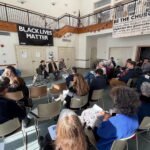
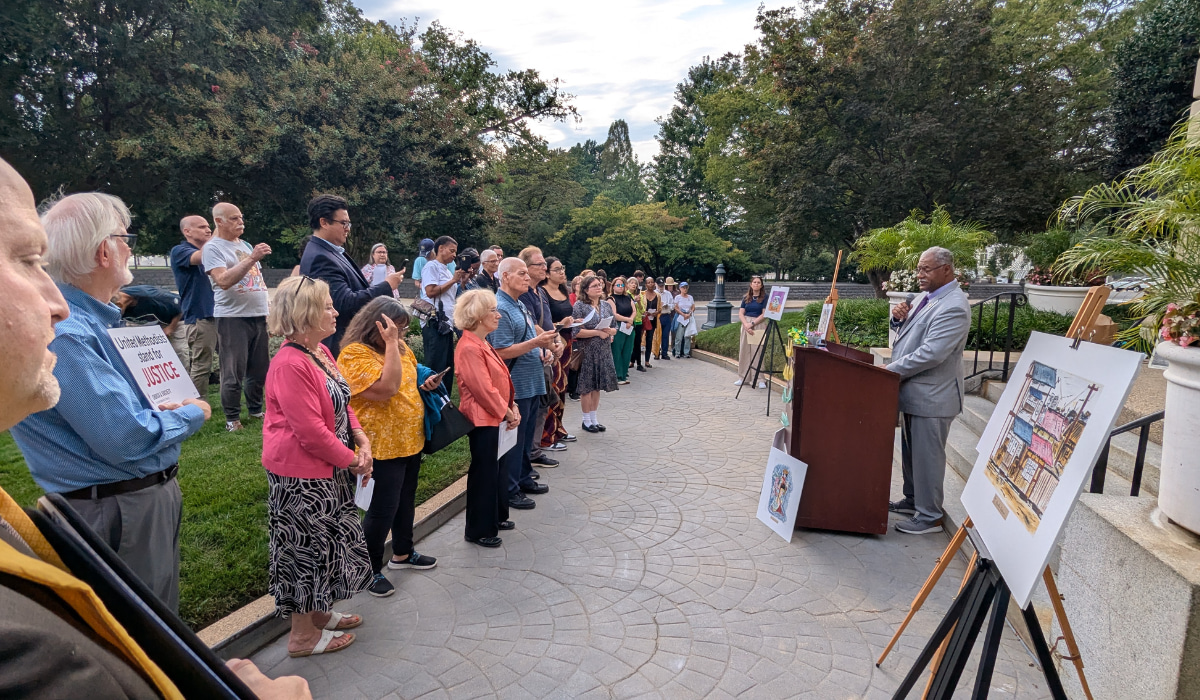
On August 6, 2025, faith leaders, peace advocates, and community members gathered at the United Methodist Building on Capitol Hill to mark the 80th anniversary of the atomic bombings of Hiroshima and Nagasaki.
Held in solidarity with Nuclear Prayer Day, organized by Voices for a World Free of Nuclear Weapons, the vigil was convened by a coalition of religious and advocacy organizations. A full list can be found here.
Through prayer, reflection, music, and calls to action, participants honored the victims and recommitted to the urgent work of nuclear abolition.
A Sacred Space for Peace
In his welcome, Bishop Julius C. Trimble, General Secretary of The United Methodist Church-General Board of Church and Society reminded attendees that for over a century, the United Methodist Building has served as a steadfast symbol of Methodist social witness for peace and justice on Capitol Hill.
He reflected on the church’s pivotal role in 1962, when it mobilized in support of President Kennedy’s call to the United Nations for a “race for peace” rather than a race toward arms.
Bishop Trimble described the church’s vision of peace not as a distant ideal, but as a dynamic and transformative reality—where swords and spears are refashioned into instruments of healing, and historic adversaries learn to dwell together in trust.
“Peace is not simply the absence of war… It is that emerging dynamic reality envisioned by the prophets of old.”
A Crayon Rebellion Rediscovered
Rev. Rob Keithan of All Souls Church, Unitarian shared a powerful story: drawings created by Hiroshima schoolchildren using supplies sent by the All Souls congregation after the bombing.
Bright and full of life, the drawings traveled back to All Souls, toured the United States, then were tucked away and forgotten—until they were rediscovered in 2012. More than 60 years later, Hiroshima survivors were reunited with their childhood artwork, bridging generations through memory, healing, and hope.
📽️ The documentary Drawings from a Hiroshima Schoolyard captures this story. One artist, now elderly, recalls: “It was the first time we saw colors.”
He recalled how vividly the colors of the crayons and school supplies stood out—because the atomic bomb had obliterated nearly everything organic. It was the first time they had seen color again.
These drawings weren’t just art—they were resurrection.
Songs of Memory and Resistance
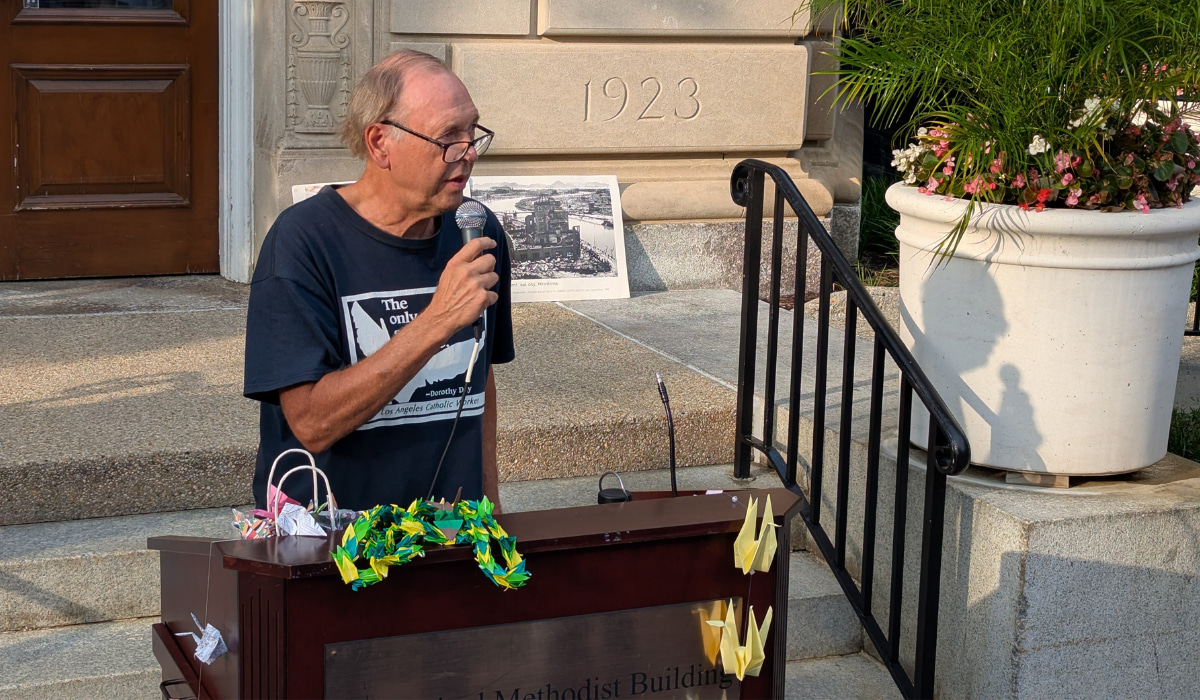
Art Laffin of the Dorothy Day Catholic Worker led the vigil in song, sharing verses from “Never Again the A-Bomb,” written in 1955 by Ishiji Asada and Kōki Kinoshita.
The song was originally introduced to American audiences by Pete Seeger, who offered a haunting rendition—first in English, then in Japanese. At the vigil, Art sang the original Japanese lyrics, honoring the hibakusha’s legacy.
Our hometown, Hiroshima, was burnt down.
We buried our family’s bones in the charred soil.
Now white flowers are blooming on the soil.
We will never allow another atom bomb to fall on our hometown.
The lyrics echoed across the steps like a prayer—grief transformed into resistance.
Buddhist Voices for Peace
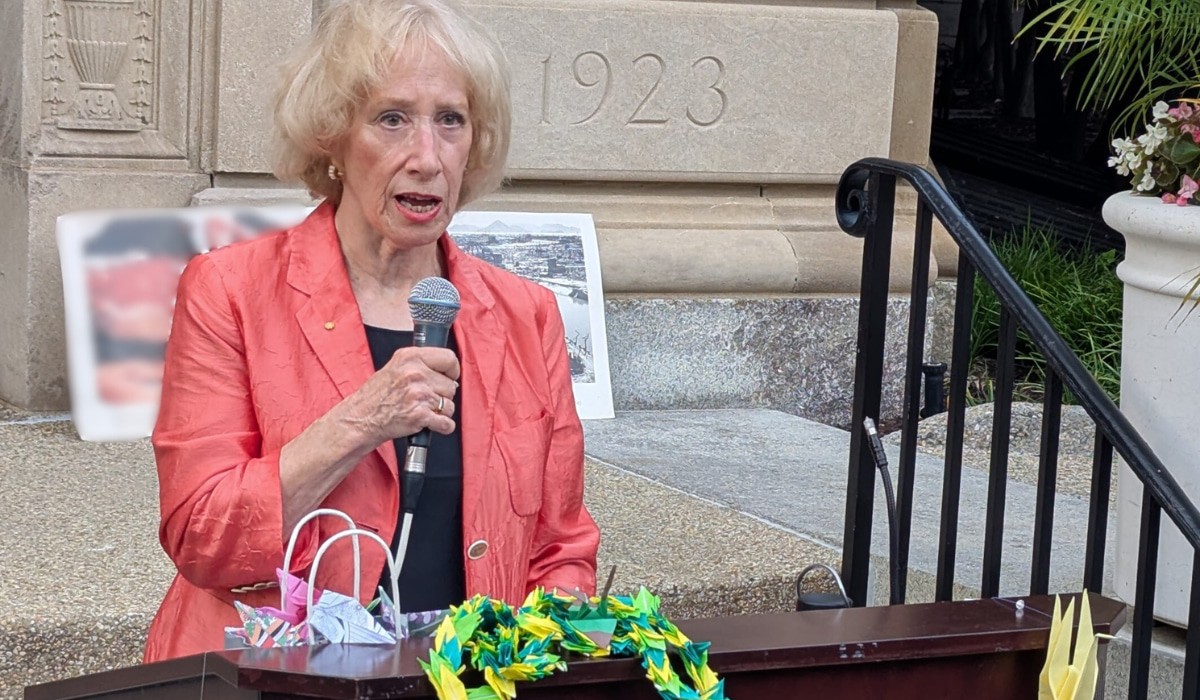
Jo Reed, representing SGI-USA (Soka Gakkai International-USA), shared her personal journey as a Nichiren Buddhist and her visits to Hiroshima, which deepened her commitment to nuclear abolition.
She affirmed Soka Gakkai’s unwavering commitment to nuclear abolition, a dedication that has spanned more than sixty years. From a Buddhist perspective, nuclear weapons reflect fundamental darkness—the delusions that fuel hatred and disregard for life.
“By confronting these delusions,” she said, “we awaken our potential for enlightenment and embrace the dignity of others.”
Quoting SGI founder Daisaku Ikeda: “The real enemy is the thinking that justifies nuclear weapons—the readiness to annihilate others.”
Jo closed with a reminder from Nelson Mandela: “It always seems impossible until it’s done.”
A Global Call for Justice
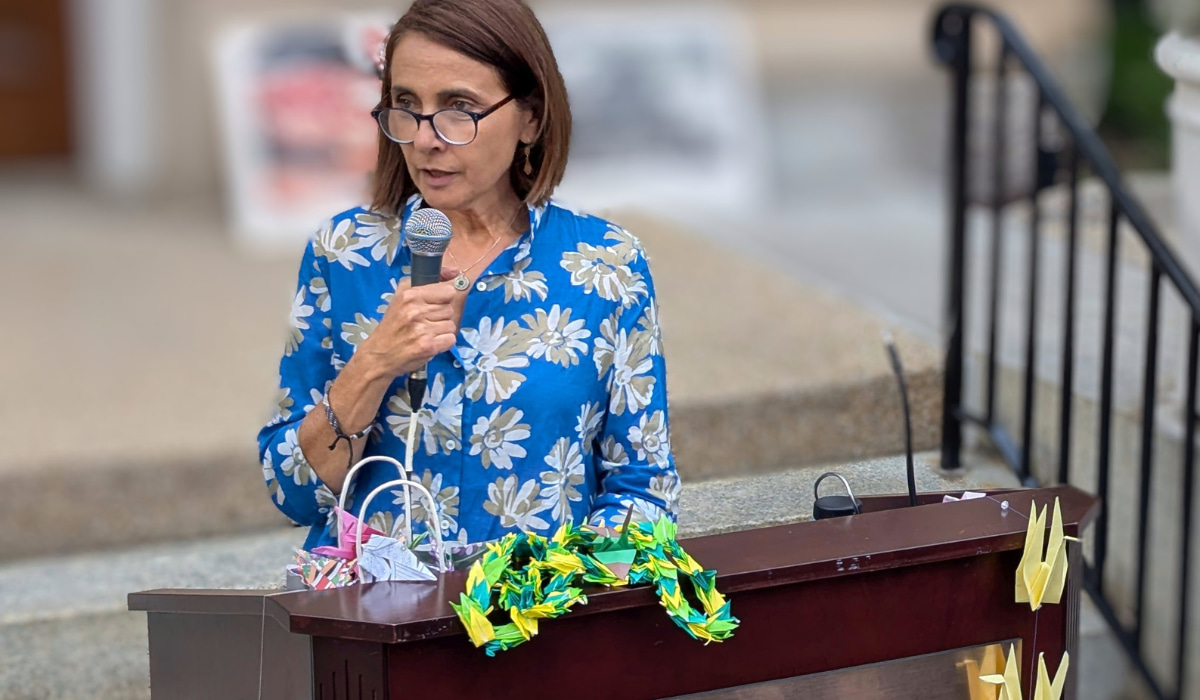
Joyce Ajlouny of the American Friends Service Committee (AFSC) named the broader harms of the nuclear age:
- Uranium mining on Indigenous lands
- Secret tests in the Marshall Islands and Nevada
- Generations exposed to radiation
- A global system built on fear and domination
“Nuclear weapons are a tool of destruction and a politics of control. As people of faith, we must say: this has no place in our future.”
Within days of the 1945 bombings of Hiroshima and Nagasaki, the AFSC—alongside other religious organizations—called on President Truman to abolish nuclear weapons entirely, issuing a moral demand that has echoed through every decade since in public witness.
The Catholic Church’s Moral Stand

Marie Dennis of Pax Christi International highlighted the Catholic Church’s evolving stance. In 2017, Pope Francis condemned the possession of nuclear weapons:
“There is no moral justification for the possession of nuclear weapons.”
This week, Pope Leo reaffirmed that nuclear arms “offend our shared humanity.” Catholic bishops from the U.S. and Japan are on a pilgrimage of peace, joined by students from universities in Nagasaki, Tokyo, Georgetown, Loyola Chicago, and Notre Dame.
Marie urged faith communities to mobilize boldly:
“It is time to replace the logic of violence with a new logic of nonviolence—training us for active love and healing.”
🎥 Congressional Voices: Honoring Memory, Inspiring Action
Seven members of Congress—each a co-sponsor of H. Res. 317, a resolution calling for U.S. leadership in preventing nuclear war and advancing disarmament—recorded video messages in support of the Nuclear Prayer Day Vigil in Washington, D.C. Their reflections honored the lives lost in the atomic bombings, uplifted the voices of survivors, and encouraged attendees to remain steadfast in the pursuit of a world free from nuclear weapons.
The participating lawmakers were:
- Rep. Jim McGovern (MA-02)
- Rep. Pramila Jayapal (WA-07)
- Rep. Rashida Tlaib (MI-12)
- Rep. Delia Ramirez (IL-03)
- Rep. Judy Chu (CA-28)
- Rep. Jesús “Chuy” García (IL-04)
- Rep. John Garamendi (CA-08)
By linking moral responsibility with legislative action, these lawmakers reminded participants that remembrance must be transformed into advocacy.
From Memory to Movement
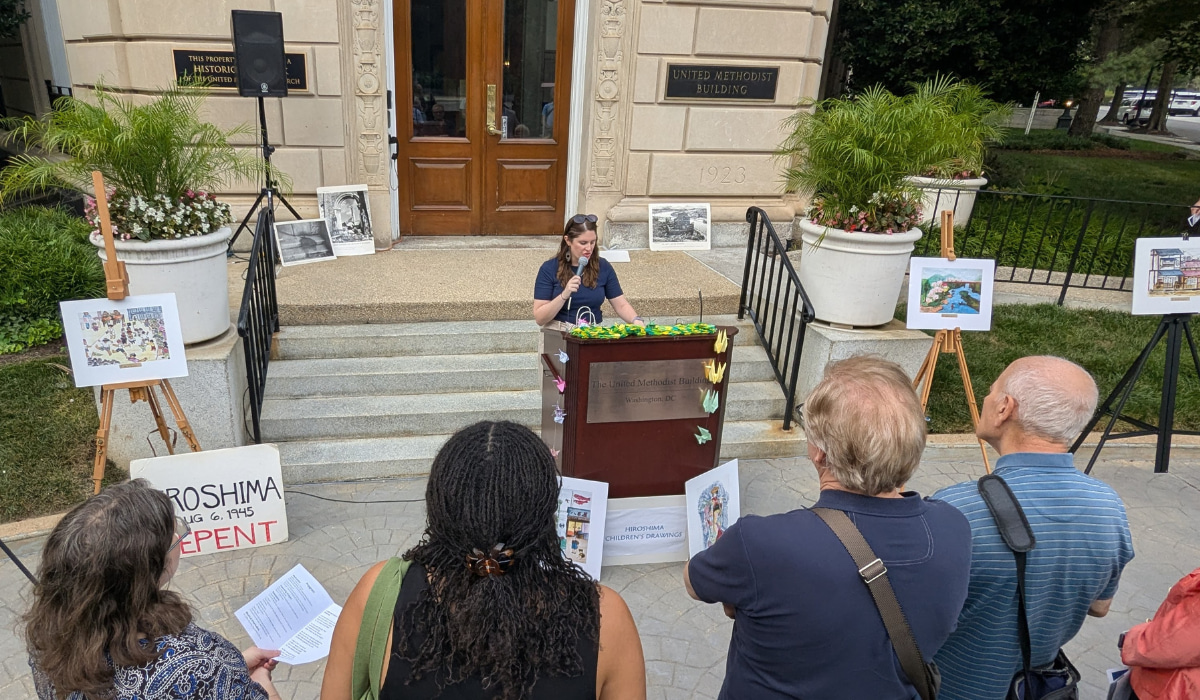
Colleen Moore of the General Board of Church and Society offered a reflection that grounded the vigil in both moral urgency and spiritual resilience. She reminded attendees that:
“Humanity is capable of apocalyptic harm—but also of solidarity for life and well-being.”
Her words echoed the heart of the day: a call for faith communities to rise with courage and compassion, to reject the politics of greed and militarism, and to demand a future rooted in grace. As she noted, while Congress approved a staggering $1 trillion defense budget for FY2025—cutting billions from healthcare, education, and food assistance—people of faith must choose witness, not warheads.
This vigil was more than remembrance—it was a roadmap for action.
We’ve prayed. We’ve reflected. Now it’s time to act.
A Call to Action: Witness, Not Warheads
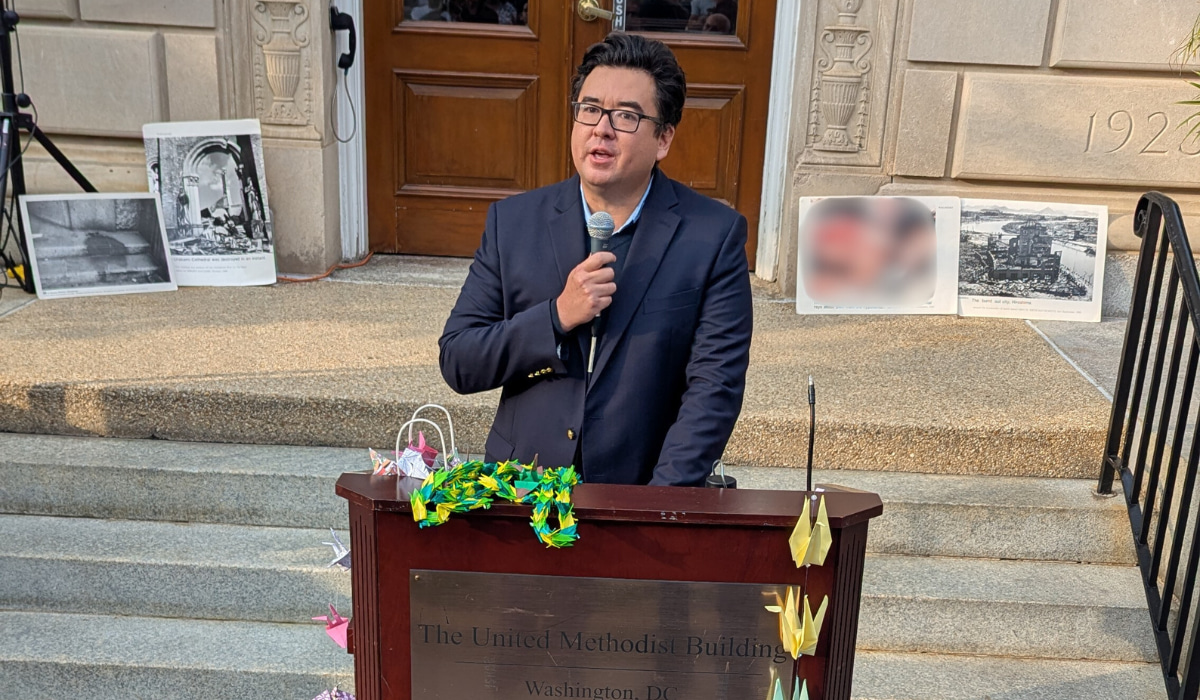
As Back from the Brink’s Capitol Hill Representative and Faith Community Outreach Coordinator, I had the privilege of offering a call to action during the vigil.
Standing before a community of advocates and faith leaders, I invited us to carry the spirit of the day forward—not just in memory, but in movement.
I urged attendees to reflect, pray, and act: to carry this moral call into pulpits, policy meetings, and places of learning. The moment was deeply humbling. In the shadow of the Capitol dome, I felt the weight of history—and the urgency of our collective responsibility.
It was a privilege to speak not only as an advocate, but as someone deeply rooted in the moral and spiritual dimensions of this work.
Take Action: Faith-Based Tools for a Nuclear-Free Future
The August 6 vigil was not an endpoint—it was a beginning. Originally launched to equip attendees of the DC Nuclear Prayer Day Vigil, Back from the Brink’s Event Resources Hub now offers readers of this blog the same tools to turn reflection into meaningful action.
- 📝 One-click advocacy links for H. Res. 317 and S. Res. 323
- 📄 The August 6 Faith-Based Resource Guide
- 🎥 Video messages from members of Congress
Whether you’re leading a prayer service or meeting with elected officials, these resources offer practical ways to pray, reflect, and act for a nuclear-free future.
Our future isn’t written in warheads—it’s written in witness.
The August 6 vigil was a beginning, not a conclusion. And now, the call extends to you. If you’ve read this far, you’ve already begun. Let your reflection become resolve. Let your prayer become movement. Let your voice ripple outward—into congregations, classrooms, and congressional offices.
Because peace is not passive. It is made real by ordinary people making extraordinary commitments to each other.
Review the guide. Share the tools. Speak with courage. And then do it again tomorrow.
This is how movements grow. This is how policies change.
And this is how we build a world where dignity triumphs over destruction, and hope outlasts the bomb.
- Alliance of Baptists
- All Souls Church, Unitarian
- American Friends Service Committee
- Back from the Brink Coalition
- Church of the Brethren Office of Peacebuilding and Policy
- Friends Committee on National Legislation
- Maryknoll Office for Global Concerns
- Pax Christi USA
- Presbyterian Church (USA) Office of Public Witness
- Soka Gakkai International-USA
- The United Methodist Church – General Board of Church and Society
- United Church of Christ
Faith traditions have long stood at the forefront of movements for peace, justice, and the sanctity of life. In this blog series, “Faith in Action: Moral Courage for a Nuclear-Free Future” we explore how people of faith are responding to the moral and existential crisis posed by nuclear weapons. Through reflections, event recaps, and contributions from our interfaith partners, this series offers a space for spiritual voices calling for disarmament—and a reminder that confronting the threat of nuclear annihilation is not just a political issue, but a deeply human and moral one.
While Back from the Brink is a secular campaign, we are proud to stand in solidarity with faith-based partners who see nuclear abolition as both a spiritual imperative and a call to justice. Together, we bear witness—and take action—for a future free from nuclear weapons.
If you’re part of a faith group that’s interested in getting involved with Back from the Brink, you can reach out to Danny Hall at danny@preventnuclearwar.org.